Real Estate Investing 2026: The Great Divide in the Rental Market and Investors’ New Survival Strategy
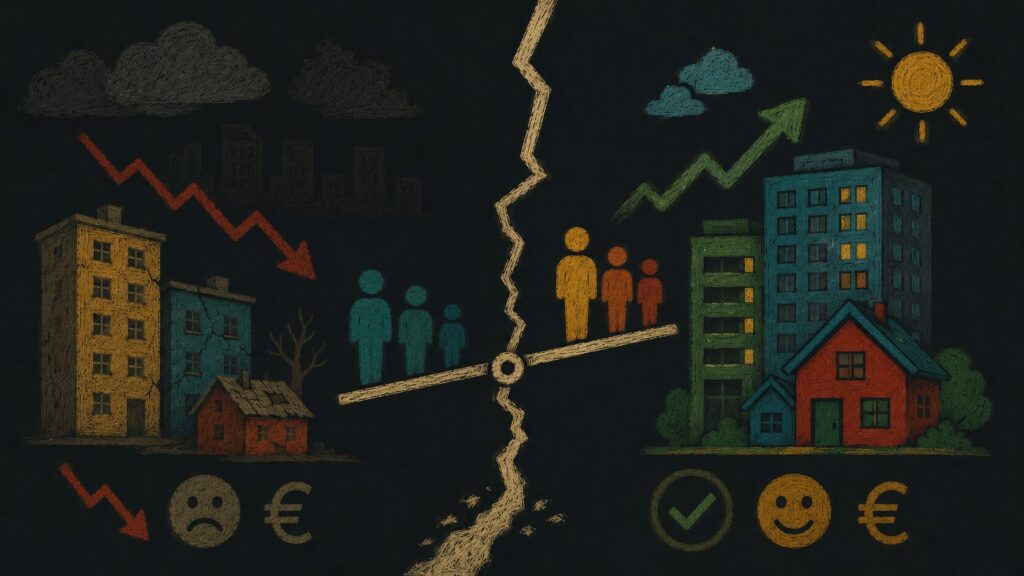
In 2026, the Finnish real estate investment sector has reached a point that could be described as a period of major reassessment. Statistics Finland’s latest figures on the development of privately financed rents in the first quarter of the year (Q1/2026) are not merely a statistical anomaly; rather, they confirm a trend that has been brewing for some time: a unified Finnish housing market no longer exists. The 0.4 percent decline in rents in the Helsinki metropolitan area and the corresponding 0.4 percent increase in the rest of Finland are symptoms of a deeper structural shift that is forcing every real estate investor to re-examine the fundamentals of their portfolio.
The Paradox of the Capital Region – From a Supply Shock to Inevitable Scarcity
The rental market in Helsinki, Espoo, and Vantaa is currently characterized by a historically severe supply shortage. It is paradoxical that even though finding tenants remains challenging and rent levels are stagnating or falling, we are simultaneously laying the groundwork for the sharpest spike in rents in a decade. The exceptional construction boom of 2021–2023 hit the market with a delay, and these apartments flooded the market just as rising interest rates put a stop to consumers’ plans to buy homes.
However, an experienced investor must look beyond the current oversupply. Building permit statistics released in early 2026 show that the volume of new construction has fallen to a level not seen in this millennium. This means that in 2027 and 2028, virtually nothing new will be completed for the market. What we are now seeing as a decline in rents is the last opportunity to acquire properties in the Helsinki metropolitan area before the supply pipeline narrows and demand pressure begins to drive up prices and rents again. The investment strategy in the Helsinki metropolitan area has indeed shifted from a pure cash flow game to a waiting game based on appreciation and liquidity, where balance sheet resilience is the investor’s most important attribute.
The New Significance of Regional Centers and the Pull of the Real Economy
While the Helsinki metropolitan area is suffering from oversupply, the rest of Finland has shifted into a new gear. However, this development is neither a coincidence nor merely a statistical balancing out. Investors’ attention has shifted to where the engines of the real economy are running hottest. Pori has risen to the top of investor barometers (57% purchase intent) in a way that reflects the industrial transformation of all of Western Finland. The green transition, investments in heavy industry, and the transformation of the energy sector are creating genuine rental demand based on wage differentials and employment—a phenomenon not seen to the same extent in recent years in the service-dominated economy of the capital region.
Rovaniemi’s rise and Tampere’s lull reflect a maturing investor mindset. Rovaniemi is currently capitalizing on both record-breaking years in tourism and the wave of geopolitical investment brought about by NATO membership. Tampere, on the other hand, has entered a phase where the years of explosive growth have already been baked into housing prices, and investors are now looking elsewhere for the next growth story. This “new realism” means that real estate investing has returned to its roots: investors are no longer buying a zip code; instead, they are investing in the local economy and its ability to attract residents.
The Return of Cash Flow and the New Mathematics of Finance
If the era of zero interest rates taught investors to focus solely on leverage, the year 2026 has restored the cash flow statement to its rightful place. A positive cash flow is no longer just a goal; it is a necessity for survival. With interest rates clearly stabilizing above zero, financing costs and rising operating expenses—such as property tax and district heating—are eating into a significant portion of gross income. This favors regions where a 6–8 percent rental yield provides sufficient breathing room for investors, whereas the 3–4 percent yield in the capital region requires investors to have exceptionally strong equity or faith in rapid appreciation.
The tightening of the financial markets has also changed the nature of the game. By 2026, banks will be evaluating housing companies’ balance sheets and energy efficiency with greater precision. ESG (Environmental, Social, and Governance) has moved from mere rhetoric directly into loan terms. An investor who owns an apartment in a housing company that has undergone energy renovations and is located in a growing area will secure financing on more favorable terms. In contrast, old, electrically heated, or poorly maintained properties will become a burden for investors, as their collateral values decline and financing costs rise.
Strategic Conclusion – Choose Your Market, Know Your Risks
The sharp divide in the rental market is both a warning and a huge opportunity for investors. Success in 2026 will require the ability to read the subtle signals of the local economy and understand construction cycles.
In the Helsinki metropolitan area, an investor must act like a value investor in the stock market: buying when others fear oversupply and trusting that a future housing shortage will bring rental rates back into line. Elsewhere in Finland, on the other hand, investors must act like analysts: seeking out those cities and neighborhoods where industrial investment and demographics align.
Real estate investing is no longer a passive means of accumulating wealth; rather, it is an active business in which success is defined by the ability to adapt to this historic turning point. Those who understand why Pori is on the rise and why Helsinki’s current lull is a sign of a storm to come are currently building the success stories of the next decade.
Sources and additional information for investors:
- Finnish Landlords Association, press release on rental statistics for Q1 2026 (April 28, 2026):Link to the press release
- Finnish Landlords Association, Landlord Barometer Fall 2025 – Regional Analysis:Link to the barometer
- Statistics Finland, Rents for Privately Financed Housing, Q1 2026:Official data from Statistics Finland
- MTV News, The Plunge in Building Permits and Its Consequences in 2026:An Article on the State of the Construction Industry
- Finnish Landlords Association, Market Outlook 2025:Analysis of the Turnaround in the Rental Market
- The European Central Bank (ECB) and the impact of monetary policy on the Nordic housing market:Interest rate decisions and forecasts