Real Estate Investing Through a Corporation – When Is It Worth It, and When Isn't It?
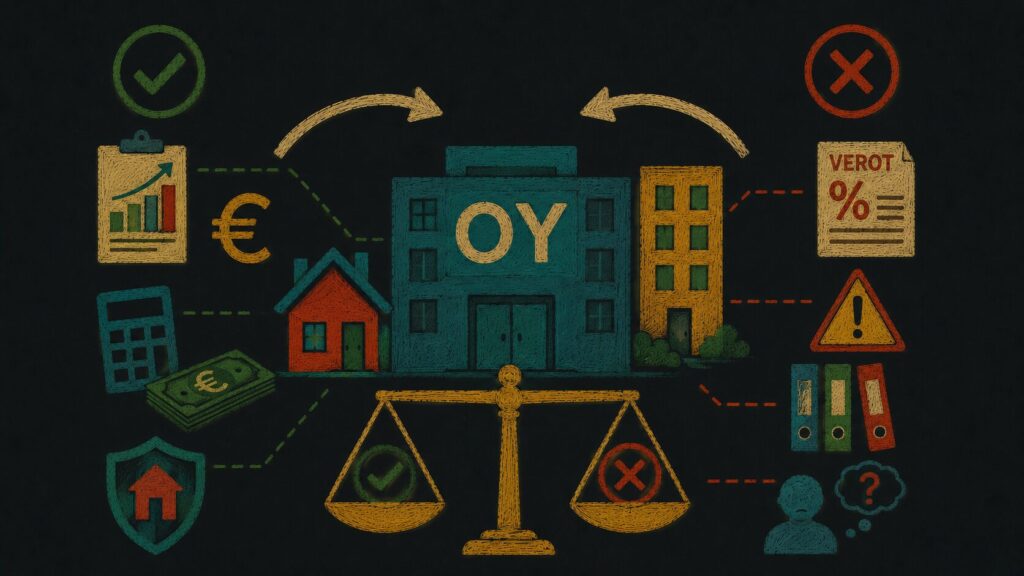
An increasing number of real estate investors are considering switching from personal ownership to a limited liability company structure. The reasons are usually tax-related, but the reality is more nuanced than simple calculations suggest. In this article, we’ll explore when a limited liability company is truly justified for a real estate investor—and when it’s mostly just an administrative burden.
The issue of owning apartments through a limited liability company has become a recurring topic of discussion among Finnish real estate investors in recent years. On investor forums and at industry events, it sparks exceptionally strong opinions: some swear by the limited liability company with almost religious conviction, while others consider it an overhyped solution that suits fewer people than is generally imagined.
The truth lies somewhere between these two extremes. The limited liability company structure is an effective tool under the right circumstances—but those circumstances arise less often than one might assume based on the current debate. In the wrong situation, the structure generates more administrative work than tax benefits, and at worst, it pays for itself only years later—if ever.
So let’s look at this topic without any sales pitches: where does the tax benefit actually come from, when does it materialize, and in what situations is it better to keep the assets in your own name?
What makes a corporation tax-advantageous?
Rental income received by an individual is taxed as capital income. The capital income tax rate is30 percent on amounts up to 30,000 euros and 34 percent on amounts exceeding that threshold. The corporate income tax paid by a limited liability company is currently20 percentofthe company’sprofits.
This is the figure that’s usually used to sell the limited liability company model: “you’ll save about ten percentage points in taxes.” The difference seems appealing, but it’s misleading for two reasons.
First of all, tax rates cannot be compared directly.Profits accumulated by a company do not remain there forever—at some point, they must be withdrawn. At that point, a second layer of tax is paid: dividend tax or payroll tax. The final tax burden is therefore determined by the sum of these two tax stages, not solely on the basis of corporate income tax.
Second, the benefit is greatest only when the returns do not need to be spent immediately.The true strength of a corporation lies in deferred taxation: when profits are left in the company to grow and are reinvested, the lower corporate tax rate allows a larger amount of capital to generate compound interest. The longer the investment horizon, the more this difference accumulates.
Good to know:The government has announced plans to lower the corporate tax rate from 20%to 18% starting in 2027. As of spring 2026, the proposal was still undergoing a consultation process and is not yet final, but if implemented, it will further enhance the advantages of the limited liability company model for long-term investors.
Key mechanism: deferred dividend
The most misunderstood—and at the same time most important—aspect of the limited liability company debate isthe taxation of dividends from unlisted companies. It is precisely this mechanism that determines how cost-effectively funds can ultimately be withdrawn from the company.
Dividends paid by an unlisted company are divided into two parts based on the company's net assets (assets minus liabilities):
- A capital income dividendis a dividend that corresponds to no more than8 percent of the mathematical value of a share(mathematical value = net assets divided by the number of shares). Of this portion, up to €150,000 per year, only25 percent is taxable capital income and 75 percent is tax-free. In practice, this means thatthe effective tax rateon the reduced dividendis only about 7.5 percent(25% × 30%). This is the true crown jewel of the limited liability company model.
- The earned income portion of a dividendis the portion of the dividend that exceeds the 8 percent threshold. Seventy-five percent of this amount is taxed as earned income along with other earned income—on a progressive basis, meaning the marginal tax rate can be quite high.
For this reason, the common claim that “withdrawing money from a corporation is always expensive” is incorrect. Within the limits of the tax-exempt dividend, money can be withdrawn with very light taxation. But—and this is crucial—the amount of the tax-exempt dividend is tied to the company’s net assets.This is precisely where many calculation examples fall short.
A Practical Comparison: Individual Ownership vs. a Corporation
Let’s look at a concrete example. An investor owns three rental properties withacombinednet rental income of 15,000 euros per year(rental income minus deductible expenses).
| Personal ownership | Corporation | |
|---|---|---|
| Net rental income | 15 000 € | 15 000 € |
| Tax in the first phase | €4,500 (capital gains tax 30%) | €3,000 (corporate income tax 20%) |
| It stays with the company / in your pocket | 10 500 € | 12 000 € |
If the fundsare left in the company to be reinvested, a corporation is clearly the more advantageous option: €12,000 remains to grow, rather than €10,500. The difference—€1,500 per year—doesn’t sound dramatic, but over several decades and with the compounding effect, it grows to be significant.
The issue becomes more complicated when you wantto withdraw the moneyfor your own use. In that case, the outcome depends crucially on how much net worth the company has.
Scenario A: The company already has net assets
Let’s assume that the company’s loans have largely been repaid and that net assets have accumulated to, say, €200,000. In this case, the limit for the tax-exempt dividend is 8% × €200,000 =€16,000—more than the €12,000 available for distribution. The entire amount can therefore be distributed as a tax-exempt dividend:
- Corporate income tax: €3,000
- Dividend tax: 25% × €12,000 = €3,000 in taxable capital income → tax: 30% × €3,000 =€900
- Total tax: €3,900, or approximately 26%
You end up with €11,100—more than the €10,500 from personal ownership. In this scenario, the corporation comes out ahead even if all the funds are withdrawn.
Scenario B: A newly established, heavily indebted company
Instead, let’s consider a newly established company acquired with high leverage, whose net assets amount to only €50,000. The limit for tax-exempt dividends is now 8% × €50,000 =€4,000. Of the €12,000 to be distributed, only €4,000 is a tax-exempt dividend; the remaining €8,000 is an earned income dividend, which is taxed progressively on top of the investor’s other earned income:
- Corporate income tax: €3,000
- Reduced dividend (€4,000): tax of approximately €300
- Dividend from earned income (€8,000): 75% taxable → €6,000 is taxed as earned income; for example, at a 40% marginal tax rate, the tax amounts to approximately €2,400
- Total tax: approximately €5,700, or nearly 38%
In this situation, a corporation is clearly more expensive than personal ownership if everything is cashed out immediately.
The key takeaway is this:the tax advantage of a corporation is not fixed. It builds up over time as loans are paid down and net worth grows. For a starting, indebted investor who needs immediate income to live on, the structure may be tax-disadvantageous. For a long-term wealth builder, it becomes more attractive year by year.
The figures in the examples are approximate and simplified. The actual tax burden depends on factors such as the investor’s other income, the municipal tax rate, the company’s audited balance sheet, and deductions.
When is a corporation truly a sensible choice?
A limited liability company structure becomes a viable option when several of the following conditions are met simultaneously:
- A significant level of rental income.In practice, this means at least €30,000–50,000 in net rental income per year, so that the administrative work and costs are in reasonable proportion to the benefits achieved.
- There is no need to increase returns in the coming years.Investors can leave the rental income in the company to grow and reinvest it. This is precisely the core of the entire model.
- Growth strategy and reallocation.The goal is to actively expand the portfolio, with the additional capital generated by the lower corporate tax rate driving growth.
- A long-term succession plan.The gradual transfer of shares in a corporation to the next generation is generally much simpler than the transfer of individual homes, and it also offers opportunities for tax relief on inheritance and gift taxes.
- High earned income from other sources.If an investor already has earned income subject to high marginal tax rates, the company can optimize a combination of salary and tax-deferred dividends so that the overall tax burden remains moderate.
Rule of thumb: the longer the investment horizon, the larger the portfolio, and the less immediate income is needed for spending, the more suitable a stock investment becomes.
When is a corporation not a good choice?
A corporation is likely an overkill if any of the following apply:
- The portfolio contains fewer than three or four apartments.
- Rental income will be less than approximately 20,000 euros per year.
- Investors need a steady stream of rental income for their personal finances.
- The investment activities are still in their early stages and heavily leveraged, meaning that net assets—and thus the amount of dividends paid—are low.
With a small portfolio,administrative costscan eat up the entire tax benefit. Bookkeeping, financial statements, a potential audit, and legal advice typically cost several thousand euros a year in total. If the tax benefit is of the same magnitude, the structure does not yield a net benefit—it merely shifts money from the tax authorities to the accounting firm.
Especially in the current market situation, where housing prices are low and there are plenty of buying opportunities, establishing a limited liability company simply because “that’s how it’s done” can lead to a situation where the investor pays unnecessary administrative costs for years before the structure begins to pay for itself. In such cases, it would be better to direct the capital toward the properties themselves.
Transition from existing properties to a corporation
One issue that is often overlooked in this discussion is what happens when an investoralready owns apartments personallyand wants to transfer them to a limited liability company. This involves two significant tax costs that are easily overlooked in the excitement.
1. Capital gains tax.Selling apartments to the company triggers capital gains tax, which is30–34 percent of the profit. If the properties were purchased years ago at a low price and their value has since risen, the tax liability can be substantial.
2. Transfer tax.In addition, the acquiring company pays transfer tax on the purchase:3 percentof the purchase price for freehold properties and1.5 percentfor housing shares (shares in a housing or real estate company). This is also calculated on the total purchase price, not just on the profit.
An alternative to a sale isa contribution-in-kind, in which the apartments are transferred to the company as assets through a capital contribution. This can defer tax consequences, but the arrangement requires careful legal and tax planning—and tax consequences can also arise from a contribution in kind, so it’s not worth assuming there are any shortcuts.
This leads to one of the most important practical lessons of this entire topic:it’s best to set up the corporate structure before making your first purchase, not after you’ve already built up a portfolio in your own name.A transfer made after the fact is almost always more expensive than a chain of ownership that’s been set up correctly from the start.
Other factors to consider
Taxation isn't the only factor to consider. When making a decision, it's also worth weighing the following:
- Financing.Banks treat corporate investments differently than they do individual customers. Loan terms, down payments, and personal guarantees may vary, and credit terms for start-up companies are sometimes stricter.
- Depreciation.When a company directly owns real estate, it can claim annual depreciation on the building, which reduces taxable income and defers taxation. There is no corresponding right to claim building depreciation when owning housing shares.
- Liabilities and risks.In principle, a limited liability company limits liability to the company’s assets, but in practice, personal guarantees for loans often undermine this protection for first-time investors.
- Continuity of management.The company requires that accounting records, financial statements, and corporate formalities be maintained every year—even in years when business activity is slow.
Summary
A corporation is neither a magic trick nor a trap for real estate investors—it is a tool whose value depends entirely on how it is used. The tax benefit is real, but it only materializes on a certain scale and over a certain time frame: when the portfolio is large enough that returns aren’t needed immediately for consumption and funds are left in the company to grow, the lower corporate tax rate and tax-deferred dividends form a genuinely effective combination.
For a small investor, a new investor, or one who needs cash flow immediately, this structure often creates more of an administrative burden than it does benefits. The decision should not be based on the excitement of a forum discussion, but rather on your own situation, goals, and time horizon—and preferably before making your first purchase.
This article is a general overview and does not replace personalized tax or financial advice. Taxation is always determined based on the investor’s individual circumstances, and regulations are subject to change. Before establishing a corporation or transferring assets, it is advisable to consult a tax expert.
Frequently asked questions
Is it worth investing in real estate through a limited liability company?It’s worth it when net rental income is high (in practice, at least €30,000–50,000 per year), the investment horizon is long, and you don’t need the returns immediately for personal expenses. With a small portfolio or if you need a steady cash flow, personal ownership is usually simpler and more cost-effective.
How much tax does a corporation pay on rental income?The company pays a 20% corporate income tax on its profits (to be reduced to 18% in 2027). When profits are distributed as dividends, a second layer of taxation applies: tax-exempt dividends (up to 8% of the company’s net assets) are taxed at an effective rate of only about 7.5%, while the portion exceeding that is taxed at a higher rate.
What is a tax-exempt dividend?A dividend distributed by an unlisted company that corresponds to no more than 8 percent of the share’s mathematical value (net assets / number of shares) and does not exceed €150,000 per year. Only 25 percent of this is taxable capital income, while 75 percent is tax-exempt.
Can I transfer my current apartment to a limited liability company without paying taxes?Not without consequences. Selling to a company triggers capital gains tax (30–34% of the profit) and transfer tax paid by the company (3% on real estate, 1.5% on housing shares). A contribution-in-kind can defer taxes, but requires expert planning. That’s why it’s worth setting up the structure before the first purchase.
Does a real estate investment company need an auditor?A small company can often be exempt from the audit requirement if it does not exceed the thresholds set by law. However, accounting records and financial statements must still be prepared every year, which incurs fixed administrative costs.
Sources
- Tax Administration – Income Taxation of Limited Liability Companies and Cooperatives:https://www.vero.fi/yritykset-ja-yhteisot/tietoa-yritysverotuksesta/tuloverotus/osakeyhtio-ja-osuuskunta/
- Tax Administration – Taxation of Dividend Income (Detailed Guide):https://www.vero.fi/syventavat-vero-ohjeet/ohje-hakusivu/47901/osinkotulojen-verotus5/
- Tax Administration – Dividends from an unlisted company:https://www.vero.fi/henkiloasiakkaat/omaisuus/sijoitukset/osingot/osingot-listaamattomasta-yhtiosta/
- Tax Administration – Taxation of Rental Income:https://www.vero.fi/henkiloasiakkaat/omaisuus/vuokratulot/
- Tax Administration – Transfer tax on the sale of real estate:https://www.vero.fi/henkiloasiakkaat/asuminen/varainsiirtovero/
- The Taxpayers' Association of Finland – Dividend taxation for unlisted limited liability companies:https://www.veronmaksajat.fi/neuvot/henkiloverotus/sijoittaminen/osingot-yksityishenkiloilla/listaamattoman-osakeyhtion-osinkoverotus/
- The Central Association of Taxpayers – Transfer Tax:https://www.veronmaksajat.fi/neuvot/henkiloverotus/asuminen-ja-auto/asunnon-osto/varainsiirtovero/
- Ministry of Finance – Proposal to reduce the corporate tax rate by two percentage points (April 28, 2026):https://vm.fi/-/yhteisoveroa-ehdotetaan-alennettavaksi-kahdella-prosenttiyksikolla
- Finnish Entrepreneurs – Setting up a limited liability company:https://www.yrittajat.fi/tietopankki/perustaminen/yritysmuodot-ja-vastuut/osakeyhtio/
- Finlex – Income Tax Act (1535/1992):https://www.finlex.fi/fi/laki/ajantasa/1992/19921535