The Interest Rate Cycle 2022–2026: What Euribor Taught Real Estate Investors

In February 2021, the 12-month Euribor stood at −0.511 percent. Two and a half years later, it was over 4.2 percent. By the spring of 2025, the rate had fallen again to 2 percent, and many were quick to declare that cheap money had returned. Then came the energy shock, and in November 2026, the Euribor stands at 3.3 percent. The interest rate cycle is not over, which is precisely why it’s worth reviewing its lessons now.
Finnish real estate investors have experienced three different worlds in five years. At first, money was practically free, and leverage turned even a mediocre property into a good investment. Then mortgage rates in Finland rose more than anywhere else in the eurozone, and cash flow turned negative for many properties. Third came a year of relief, which turned out to be just a brief respite.
This article does not predict where interest rates are headed. The track record of forecasts in this cycle has been embarrassing, as we’ll see later. Instead, we’ll look at how interest rates moved, why Finland was hit particularly hard by them, what that meant for the financial calculations of an individual investment property, and what lessons can be learned from all of this.
Three phases in five years
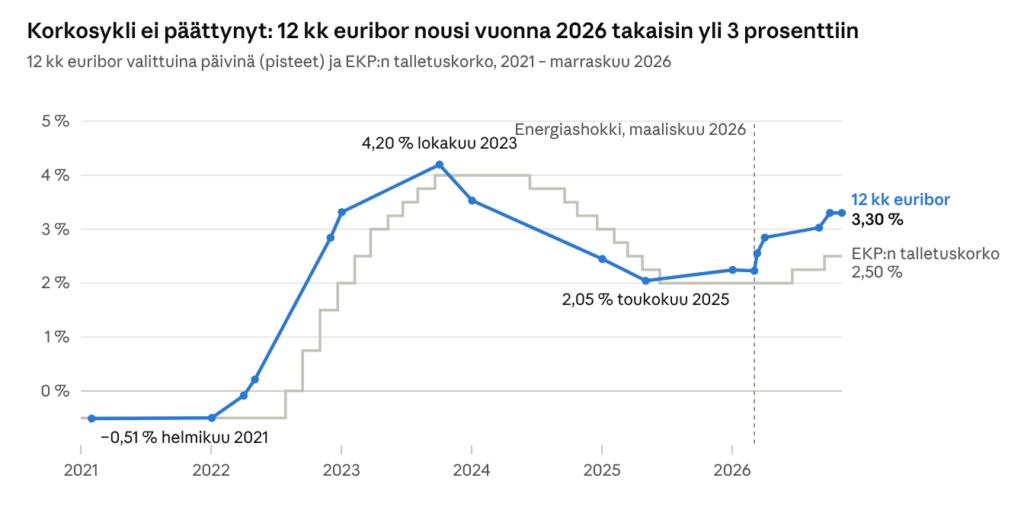
Euribor: EMMI / euribor-rates.eu and the Bank of Finland (November 4, 2026). Deposit rate: European Central Bank.
The era of zero interest rates came to an abrupt end
The European Central Bank’s deposit rate was −0.50 percent from September 2019 to July 2022. The 12-month Euribor rose into positive territory in April 2022 and stood at 2.842 percent by December of that year. The ECB raised interest rates ten times in a row, and by September 2023, the deposit rate stood at 4 percent. The Euribor peaked on September 29, 2023, when it reached 4.228 percent.
In Finland, the increase was felt more acutely than elsewhere. According to an analysis by the Bank of Finland, the average interest rate on new mortgages in Finland rose by 3.91 percentage points between November 2021 and November 2023—the largest increase in the entire euro area. The euro area average was 2.83 percentage points. In November 2023, the average interest rate on the outstanding mortgage balance was 4.04 percent in Finland, compared with an average of 2.4 percent in the euro area.
An Intermediate Stage of Relief
Starting in June 2024, the ECB cut interest rates eight times, and by June 2025, the deposit rate stood at 2 percent. In early May 2025, the Euribor was just 2.045 percent. The average interest rate on new mortgages fell from 4.55 percent in July 2023 to 2.84 percent in January 2026. The housing market recovered significantly in 2025, and 2026 was expected to be a turning point.
Back to the top
In March 2026, the conflict in the Middle East caused energy prices to spike, and the Euribor experienced its largest single-day increase in nearly 18 years. According to preliminary data, inflation in the euro area accelerated to 3.3 percent in August as energy prices rose 14.3 percent. The ECB raised the deposit rate to 2.25 percent in June and to 2.50 percent in September. At its October meeting, interest rates were kept unchanged.
The average interest rate on new mortgages was already 3.54 percent in September 2026. On November 4, the 12-month Euribor stood at 3.302 percent, roughly the same level as at the beginning of 2023. In a year and a half, the rate had risen by nearly 1.3 percentage points from its trough.
It’s worth keeping this in mind. In many investment projections, the 2025 interest rate was considered the “new normal,” and projections were built on that assumption. In reality, it was merely the lowest point in the cycle.
Why Does Finland Feel the Impact of Interest Rate Hikes Faster Than Other Countries?
A distinctive feature of Finnish mortgage debt is its linkage to the Euribor. According to the Bank of Finland, as of the end of May 2026, 95 percent of mortgages were tied to the Euribor, and just under 4 percent had fixed interest rates. Of the loan agreements signed between 2003 and 2023, 96 percent were variable-rate loans.
This structure has had both advantages and disadvantages. In the long run, it has been favorable for Finnish borrowers: According to calculations by the Bank of Finland, the average interest rate on the mortgage portfolio in Finland was 2.28 percent between 2003 and 2023, compared to 3.42 percent in the euro area. The price for this is paid when interest rates rise rapidly. The impact is felt by Finnish households and investors within a few months, whereas a German or French borrower with a fixed-rate mortgage may not notice it until years later.
In recent years, two trends have driven developments in different directions. The popularity of fixed-rate loans has grown: from January through May 2026, fixed-rate loans accounted for nearly 6 percent of new mortgages, the highest level since 2013. At the same time, many borrowers opted for shorter-term reference rates. The share of new loans tied to the 12-month Euribor fell from 73 percent to 59 percent over the course of a year, while the shares of the 3- and 6-month Euribor rates increased. A shorter reference rate means that the next interest rate hike will be reflected in mortgage payments more quickly than before.
There are no recent official figures on the coverage of interest rate hedges. According to the Bank of Finland, about a quarter of the mortgage portfolio was hedged in June 2022. In a survey conducted by Nordea in February 2026, only 9 percent of mortgage borrowers reported having taken out an interest rate hedge, and 27 percent said they did not understand interest rate hedging well enough. While these figures measure different things, taken together they suggest that the vast majority of borrowers remain directly exposed to interest rate fluctuations.
Investor loans are a distinct, stable category of their own
According to the Bank of Finland, investment mortgages totaled 9.3 billion euros in September 2026, accounting for about 9 percent of the total mortgage portfolio. The average interest rate on new investment mortgages was 3.28 percent in May 2026. Borrowing by investors has remained surprisingly stable in 2026: in July, new investment mortgage loans increased by one percent compared to the previous year, while new owner-occupied mortgage loans decreased by six percent.
Loan terms have also lengthened. In July 2026, the average loan term for new investment mortgages was just over 21 years—more than a year longer than at the start of 2026. The increase was even steeper for owner-occupied mortgages, as the maximum loan term permitted by law rose to 40 years in June.
A corporate loan is also a debt
A unique feature of real estate investing in Finland is the housing cooperative loan. It does not appear in the investor’s own loan agreement, but it is a debt whose interest and principal payments are covered by the financing charge. According to the Bank of Finland, the total loan portfolio of housing associations stood at 47.0 billion euros in September 2026, with housing companies accounting for slightly more than half of that amount. The portfolio continues to grow, even as the household mortgage portfolio (105.5 billion euros) shrinks. Eighty-four percent of housing association loans are tied to the Euribor.
The average interest rate on housing association loans explains why financing charges fluctuate. In February 2024, it stood at 4.51 percent; by September 2025, it had fallen to 2.97 percent; and by September 2026, it was back up to 3.35 percent. At the same time, new loan origination has plummeted: in September 2026, new loans were issued at a rate nearly 39 percent lower than a year earlier—the lowest level since July 2022.
However, the fears regarding corporate loans did not materialize as such. Marja Nykänen, Vice Chair of the Board of the Bank of Finland, stated in May 2025 that the feared wave of housing cooperative bankruptcies did not occur. The problems have been concentrated in investor-driven housing companies, where the entire building or a large portion of the apartments is owned by investors. According to Nykänen, the stress tests conducted during the loan approval phase helped a great deal.
In taxation, there is a detail regarding the financing fee that affects the investor’s cash flow. According to the Tax Administration’s guidelines, the financing fee may be deducted from rental income only if the housing company recognizes it as revenue. If the association sets it aside in a reserve, the fee is added to the acquisition cost of the shares, and the deduction is only realized upon sale. The same interest payment can therefore be reflected in two very different ways in the investor’s annual tax return.
How Does the Interest Rate Affect the Calculation for a Single Apartment?
The impact of the interest rate cycle is most clearly seen through a single loan. The calculation below is an illustration, not a typical investor profile. It involves a 100,000-euro loan tied to the Euribor with a margin of 0.52 percent. According to the Bank of Finland, this is the average margin for new mortgages in January 2026. The calculation shows the interest expense for the first year on the entire loan principal, and a negative Euribor rate is treated as zero.
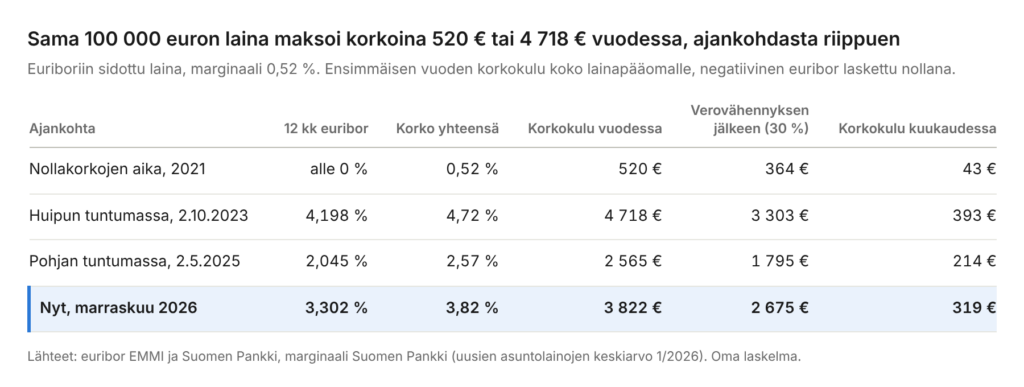
Interest on a loan taken out to purchase a rental apartment is deducted from capital income, which is taxed at a rate of 30 percent and, for amounts exceeding 30,000 euros, at a rate of 34 percent. The column in the table showing amounts after the tax deduction assumes a 30 percent tax rate.
The difference between the figures is greater than many investors had factored into their calculations during the era of zero interest rates. At its peak, the same loan cost nine times as much in interest compared to 2021. The difference between the trough and the current level is about 1,260 euros per year, or about 105 euros per month before taxes.
A suitable point of comparison is the median rent for a privately financed studio apartment in Helsinki, which, according to Statistics Finland, was 730 euros in April–June 2026. The change in interest rates over a year and a half thus accounted for approximately 14 percent of the monthly rent for such a studio apartment on a 100,000-euro loan. During the same period, privately financed rents across the country rose by 0.1–0.2 percent per year.
The loan term is a lever that works both ways
In addition to interest expenses, cash flow is affected by the loan term. The same 100,000-euro loan at an interest rate of 3.82 percent looks like this as a fixed-payment loan:
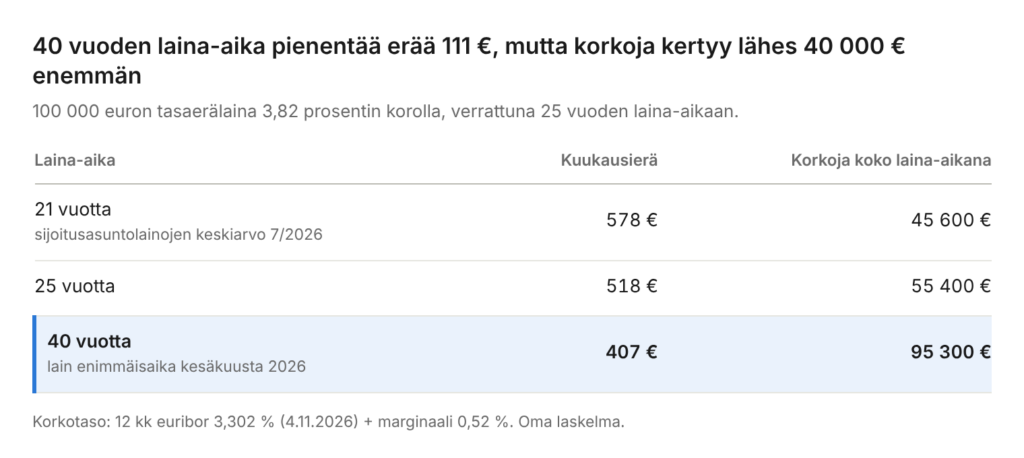
A 40-year loan term reduces the monthly payment by more than 100 euros compared to a 25-year loan, which immediately improves cash flow. The cost is approximately 40,000 euros more in interest and a slower accumulation of equity. A long-term loan also exposes the investor to more interest rate cycles, and if the cycles are as short as they were in the 2020s, there will be several of them over the course of four decades.
Regulation tightened during the previous upturn and eased during the new upturn
During the interest rate cycle, there were also changes in how much debt could be taken on and under what terms. A law that took effect in July 2023 capped new housing cooperative loans at 60 percent of the debt-free value of the shares, limited the loan term to 30 years, and restricted the grace period to a maximum of 12 months during the first five years. At the same time, the maximum loan term for home mortgages was set at 30 years. These restrictions were a response to trends in the late 2010s, when an increasingly large portion of the price of new developments was financed by housing corporation loans.
In 2026, the tide turned. In April, the Parliament passed a law that extended the maximum term for a mortgage to 40 years, effective June 1, 2026. The government had proposed 35 years, but the Finance Committee raised the limit. The same law allows the Council of State to issue a regulation raising the maximum loan-to-value ratio for housing cooperative loans to 70 percent, extending the repayment-free period to 24 months, and extending the loan term to 40 years. The Ministry of Finance’s draft regulation was sent out for public comment in May. For its part, the Financial Supervisory Authority raised the maximum loan-to-value ratio for loans other than first-time homebuyer loans from 90 percent to 95 percent effective July 1.
The easing measures had a rapid impact. In May 2026, mortgages with terms of more than 30 years accounted for 6 percent of new loans; by July, that figure had risen to over 16 percent.
The stress test is the most important brake
Finland does not have a household debt ceiling—that is, a maximum debt limit relative to income. The Bank of Finland and the Financial Supervisory Authority have been advocating for such a measure for years, but the 2026 reform went in the opposite direction. As early as May 2025, the Bank of Finland stated that it saw more risks than benefits in any relaxation of the rules.
A practical obstacle is the Financial Supervisory Authority’s recommendation that banks assess a loan applicant’s ability to repay based on a 6 percent interest rate and a 25-year loan term. For the €100,000 loan discussed in the previous section, this translates to a monthly payment of approximately €644, whereas the actual payment at current interest rates and with the same loan term is about €518. The significance of this test became apparent in 2023: the Euribor rose above 4 percent but remained well below the test rate, and the vast majority of borrowers were able to meet their obligations.
From an investor’s perspective, the situation is contradictory. Regulations now allow for longer loan terms and higher loan-to-value ratios just as interest rates are rising again. What is legally permissible is not necessarily what makes sense for an investor.
Six Lessons from the Interest Rate Cycle
1. Zero was not the norm.Negative interest rates were the exception, not the baseline. The average interest rate on Finnish mortgages was 2.28 percent between 2003 and 2023. A calculation based on an interest rate of less than one percent was, in reality, a gamble on interest rates.
2. Cash flow is reliable; capital appreciation isn’t always.According to Statistics Finland, real housing prices are about 28 percent lower than at their peak in 2021. An investor whose property generated positive cash flow even at a 4 percent interest rate was able to wait. An investor whose return depended on capital appreciation was, at worst, forced to sell in a declining market.
3. A housing company loan is a debt, even if it is not in your name.The interest rate on the loan tracks the Euribor just like a personal loan. The Bank of Finland’s observation that the problems were concentrated in investor-driven housing companies also indicates that the ownership structure of a housing company is part of the risk.
4. Liquidity is a risk in itself.Open-ended real estate funds were a way for many people to own apartments without the hassle. According to the Financial Supervisory Authority, by November 2025, 10 out of 27 open-ended specialized real estate investment funds had already restricted or postponed redemptions. Selling a directly owned home isn’t quick either: from January through April 2026, the average time to sell an apartment or townhouse was 135 days. When doing your calculations, it’s wise to plan for the possibility that you won’t be able to get your money out when you need it most.
5. The reference interest rate and loan term are decisions, not assumptions.A shorter Euribor term, a longer loan term, and the absence of hedging reduce the monthly payment during good times and increase it during bad times. None of these is a wrong choice in and of itself, but the choice should be an informed one.
6. It’s best to take forecasts with a grain of salt.In early 2026, the housing market was expected to turn, and price forecasts for the year were in the range of a roughly 1 percent decline. By October, the forecasts had shifted to a 2.6–3 percent decline. On the interest rate front, Nordea predicted in April that the ECB would raise rates four times by October. Two hikes actually occurred. Forecasts are useful for assessing the overall trend, but an individual investment decision should not hinge on whether any of them turn out to be correct.
What's next?
At the end of October, the ECB kept the deposit rate at 2.50 percent and said it would make decisions on a meeting-by-meeting basis. S-Bank forecasts a rise to 2.75 percent in December and to 3.0 percent in March 2027. According to the ECB’s own September projections, euro area inflation will slow from 3.0 percent in 2026 to 2.5 percent in 2027 and 2.1 percent in 2028.
From Finland’s perspective, there is one peculiarity in this picture. Finland’s harmonized inflation rate was 2.7 percent in September, while euro area inflation stood at 3.8 percent, and the Bank of Finland forecasts that Finland’s inflation will slow to 1.4 percent in 2027. Since the ECB sets its interest rates to meet the needs of the entire euro area, it is fair to say that the current interest rate level is tight relative to Finland’s own inflation trends. In a sense, Finnish borrowers are paying for part of the rest of the euro area’s inflation.
On the other hand, households are better prepared than before. According to Statistics Finland, the debt-to-income ratio—that is, the ratio of debt to disposable annual income—fell from 122.1 percent at the beginning of 2025 to 117.6 percent in the second quarter of 2026.
The post-cheap-money era is therefore not an era of high interest rates, but an era of fluctuating interest rates. In such an environment, the value of an investment property is not determined by what the interest rate is at the time of purchase, but by whether the calculation still holds up given what the interest rate might be three years from now.
Sources
- Bank of Finland: Euribor Rates
- Euribor-rates.eu: Euribor Rates by Year (EMMI)
- Euribor-rates.eu: Euribor Rates for 2025
- ECB: Key Interest Rates
- ECB: Monetary Policy Statement, September 10, 2026
- ECB Monetary Policy Decisions, October 29, 2026 (STT)
- Bank of Finland: Housing Cooperatives Took Out Fewer New Loans in September 2026 (STT)
- Bank of Finland: Interest rates on household loans rose in May 2026
- Bank of Finland: Average Mortgage Rate Has Stabilized, January 2026
- Bank of Finland: Volume of Mortgages with Longer Repayment Terms Has Increased (STT)
- Bank of Finland: Growth in Housing Cooperatives' Loan Portfolio Has Slowed (STT, 2024)
- Euro & Economy: Hirvonen, Mortgage Rates in the Eurozone (2024)
- Bank of Finland Interim Forecast, September 15, 2026 (STT)
- Yle: The Bank of Finland on Housing Association Loans, May 21, 2025
- Nordea: Less than one-tenth of mortgage borrowers have purchased interest rate protection (Verkkouutiset)
- Online News: Mortgage Lending in July Was the Lowest in 20 Years (2023)
- Parliament: EV 32/2026 vp, Restrictions on Lending
- HE 190/2025 (Bill)
- Financial Sector: Statement on the Draft Regulation on Restrictions on Housing Association Loans
- Financial Supervisory Authority: Decision on Macroprudential Regulation, June 2026 (STT)
- Tax Administration: Taxation of Rental Income
- Taxpayers: Tax Rates on Capital Income
- Statistics Finland: Residential Rents, 3rd Quarter 2026
- Statistics Finland: Median Rents for Studio Apartments, April–June 2026 (STT)
- Statistics Finland: Household Indebtedness, 1st Quarter 2025
- Statistics Finland: Household Indebtedness, 2nd Quarter 2026
- Statistics Finland: Consumer Prices, September 2026
- Statistics Finland: No Sign of a Turnaround in the Housing Market (Real Prices), August 27, 2026
- Financial Literacy: Investors Are Still Trying to Exit Real Estate Funds (FIVA)
- Hypo: Housing Market Review, March 2026
- S-Bank: Housing Market Trends, June 2026
- S-Bank's Economic Forecast, October 6, 2026 (STT)
- Nordea: Housing Market Review, October 21, 2026
- FXStreet: Nordea's ECB Forecast for April 2026

Pasi Suojala is the founder of Horisontti Group, which buys and sells apartments as its core business. The company has acquired properties worth over 30 million euros. In his articles, Pasi explains what’s really happening in the housing market and what it means for investors.