Have Housing Prices Bottomed Out? – An Analysis of the Market Situation in the Summer of 2026
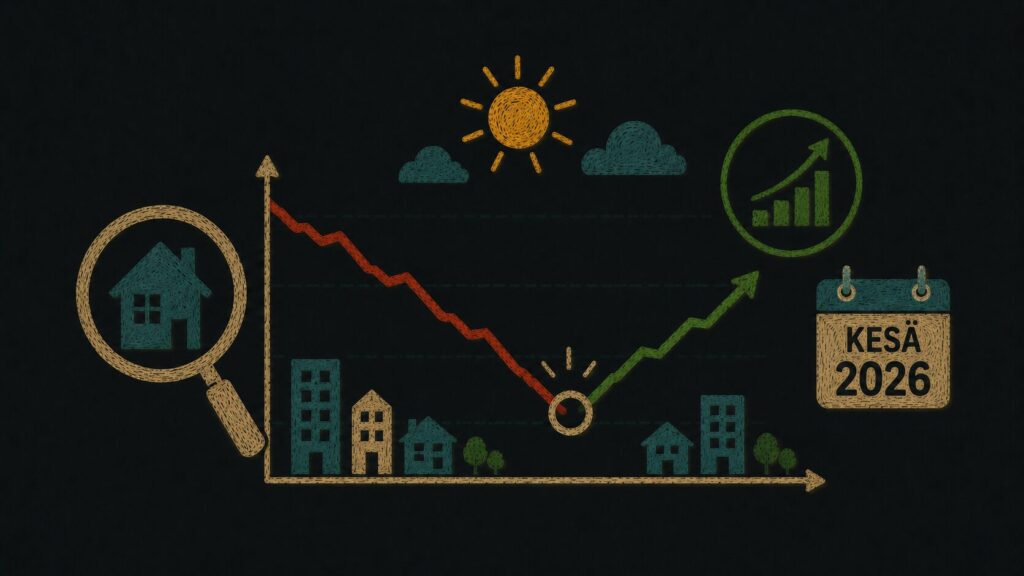
Housing sales in the spring were nearly a fifth lower than a year earlier, and prices are still clearly down year-over-year. At the same time, the first signs of a rise in apartment prices in major cities appeared early this year. Is Finland’s longest-ever housing price slump turning around—or is it still too early to declare that the bottom has been reached?
The Finnish housing market has been in decline since 2022. When the zero-interest-rate environment came to an abrupt end and the uncertainty caused by Russia’s war of aggression hit consumer confidence, a price correction began that has proven to be exceptionally long and deep. Now, in the summer of 2026, the market indicators are showing both positive and negative signals simultaneously for the first time in a long while. It is precisely this dichotomy that makes interpreting the situation difficult—and intriguing.
Before considering a turnaround, it is important to understand just how deeply the market has fallen over the past four years. The scale of this slump is the context against which every “sign of recovery” must be interpreted.
How deep was the hole, really?
The current decline in housing prices is the longest in Finnish history. Previous major downturns—the recession of the 1990s and the 2008 financial crisis—were steep but relatively short-lived; the markets rebounded from them fairly quickly. The current downturn has now stretched into its fourth year without a clear turnaround, making it different in nature from what the Finnish housing market has been accustomed to.
The decline in prices is stark. In real terms—that is, taking inflation into account—housing prices have fallen to levels last seen about twenty years ago; in effect, all of the real-value gains of the 2010s have been wiped out. Even in nominal terms, Statistics Finland’s price index for the entire country has already fallen below 2015 levels, and in the Helsinki metropolitan area, prices are roughly at 2016 levels. In other words, in most regions, more than a decade of price growth has been wiped out.
The decline in the number of transactions is just as sharp. Housing sales through real estate agents have reached their lowest level in about ten years. In April 2026, 18.5 percent fewer transactions were completed than a year earlier, and in May the pace slowed further—the decline had already reached just over 20 percent compared to the previous year. The situation in new-construction projects is downright dramatic: in April, sales of new homes were about half what they were a year earlier and a fraction of the five-year average.
The slump is most clearly felt in the collapse of new construction. The rolling annual total of housing starts has fallen from about 48,000 at the beginning of the decade to the current level of about 16,000—that is, to two-thirds of the previous figure. Fewer building permits have been applied for than even at the lowest point of the financial crisis. The last time construction came to a standstill like this was during the recession of the 1990s. This is not merely a cyclical downturn, but a deep freeze across the entire industry, the effects of which will be felt in the market for years to come.
The downturn has also affected properties unevenly. Small studio apartments built between 2017 and 2022 on leased land have been hit particularly hard: in many places, their prices have fallen by about one-fifth in just a few years, while maintenance fees for housing cooperatives have risen by nearly 50 percent since 2021. Rising maintenance costs are putting even more downward pressure on prices. From an investor’s perspective, this segment in particular has been the hardest hit by the downturn.
Against this backdrop, the green shoots seen early this year should be put into perspective: they are early signs emerging from an extremely low base, not a return to the way things used to be.
Prices – The Anatomy of a Dichotomy
The story behind price trends is more complex than the volume figures suggest, and that is precisely where the crux of the question “Have we hit bottom?” lies. In the short term, the trend appears to be reversing; in the longer term, it continues to point downward.
Prices per square meter for used apartments in the Helsinki metropolitan area rose by 0.6 percent from March to April, and for the first part of the year as a whole, prices in the Helsinki metropolitan area were up by about 0.4 percent in April compared with January. On an annual basis, however, the trend remains clearly negative.
| Region | Change: April vs. March 2026 | Change: April 2026 vs. April 2025 |
|---|---|---|
| Metropolitan Area | +0,6 % | −6,7 % |
| Other major cities | −1,6 % | −5,7 % |
| Tampere | −0,3 % | −2,8 % |
| Turku | −3,0 % | −7,8 % |
| Oulu | +0,6 % | +1,4 % |
Source: KVKL Price Monitoring Service, April 2026 report. Oulu stands out as the only major city where prices have risen on an annual basis.
An important turning point came in May. According to the latest figures, apartment prices in the Helsinki metropolitan area once again turned slightly downward (about −0.8% from April), while other major cities saw an increase. The spring surge seen earlier this year thus stalled somewhat due to heightened concerns over interest rates. This is a good reminder that monthly figures fluctuate back and forth, and one cannot draw conclusions about a trend reversal based on isolated positive figures. The situation is a classic bottoming process: initial spikes and pullbacks alternate before the trend finally stabilizes.
Sales Times – The Most Sensitive Indicator of Market Sentiment
Along with prices, sales times are one of the most accurate indicators of market sentiment, as they react more quickly to changes in demand than price indices. When homes begin to change hands more quickly, it often signals that prices are stabilizing.
We’ve seen cautious progress in the right direction. In April, the time it took to sell a townhouse in the Helsinki metropolitan area shortened by nearly three weeks, and in May, the time it took to sell a single-family home in the metropolitan area decreased by a little over a month. Still, the timeframes remain historically long: in the Helsinki metropolitan area, it still takes just over three months to sell a used studio apartment in a high-rise building, and around four months for larger homes. In 2020–2021, a well-maintained apartment changed hands in weeks, not months. We’re heading in the right direction, but the road back to normal is long—and progress is fastest in the Helsinki metropolitan area.
Structural factors that support recovery
Beneath the short-term sentiment, there are a number of structural factors that are tilting the longer-term outlook toward recovery, regardless of monthly fluctuations.
A slump in new construction.The severe slowdown in construction described above means that there will be no quick relief in supply. It typically takes two to four years from the start of a construction project to the completion of a home, so even if demand were to recover suddenly, new homes would not reach the market for years. According to the Government’s estimate, the level of construction will remain well below what is required to keep pace with population growth. When pent-up demand meets dwindling supply, price and rental pressure will eventually build up, particularly in growth centers. (We discussed this imbalance in more detail in our report“The Real Estate Investor’s Year 2025.”)
Urbanization.The concentration of the population in large cities does not stop with economic cycles. People move to growth centers in search of work, education, and services even during periods of low demand, which sustains underlying demand in desirable locations.
Improving purchasing power and a 40-year loan term.Wages have risen while prices have fallen, so the price of housing relative to income is at its most favorable for buyers in decades—a point that Tuomas Viljamaa, CEO of KVKL, has repeatedly emphasized. The 40-year maximum loan term, which took effect in early June 2026, particularly improves the affordability for first-time homebuyers and could significantly expand the pool of potential buyers. Together, these factors could bring additional demand to the market at precisely the time when supply is at its lowest.
These structural forces do not guarantee a rapid turnaround, but they form the foundation upon which recovery can be built as soon as confidence returns.
Why can't the bottom be identified in real time?
It is well known that it is impossible to pinpoint the bottom of the housing market when it actually happens. The bottom is always seen in hindsight: only once prices have clearly begun to rise and the trend can be confirmed by statistics can we say, in retrospect, in which month the turnaround occurred. This typically takes months.
This is due in part to the lag in the statistics and in part to the fact that the bottom is not a single point but a phase—precisely the kind of two-part period we are currently in. Adding to the complexity are the block trades between investors that have entered the market; the volume discounts in these trades are weighing down price indices, even though they do not reflect the prices faced by the average homebuyer. The signal is therefore noisy.
What does this mean for investors?
The practical conclusion is that waiting for the bottom to be certain is not a sensible strategy—because certainty is only achieved once the most favorable moment has already passed. A more useful approach is to assess whether the price and cash flow projections for a specific property make sense as a long-term investment based on current figures. If the rental income, location fundamentals, and cost of financing hold up over a ten-year time horizon, it ultimately matters little whether you buy one percent “too early” or “too late” relative to the exact bottom.
This does not mean that now is the time to buy just anything. The depth of the slump serves as a reminder that the market punishes weak fundamentals mercilessly: the price collapse of studio apartments on leased lots shows that the wrong property will generate losses even when the overall trend eventually reverses. Analytical screening—location, cost structure, maintenance fee trends, and rentability—matters more than timing.
The summer of 2026 may later turn out to be one of the best times to buy in a decade. But only history will confirm that—and an investor’s job is to make decisions based on fundamentals, not on predictions.
Summary
The Finnish housing market has experienced the longest price decline in its history: real prices are at levels last seen two decades ago, transaction volumes are at a ten-year low, and new construction has plummeted to two-thirds of its peak. Against this backdrop, the early signs of a recovery in early 2026 are significant but fragile—the dip in the Helsinki metropolitan area in May serves as a reminder that the turnaround has not yet been confirmed.
Longer-term structural factors—limited supply, urbanization, rising purchasing power, and longer loan terms—are supporting the recovery. However, investors should focus on a property’s fundamentals rather than trying to time the bottom of the market, as it is these fundamentals that will determine returns even when the market eventually turns.
This article is a general market overview; it is not an investment recommendation or personal investment advice. The figures presented are based on sources available at the time of writing and are subject to change. Investment decisions should be made based on your individual circumstances and, if necessary, in consultation with a professional.
Frequently asked questions
Will housing prices be rising or falling in the summer of 2026?The picture is mixed. Prices for apartment buildings in the largest cities saw a slight increase on a monthly basis early this year, but on an annual basis, prices are still clearly down (by about −6–7% in the Helsinki metropolitan area). In May, prices in the Helsinki metropolitan area turned downward again, so the turnaround has not yet been confirmed.
How much have housing prices fallen from their peak?This decline is the longest in Finnish history. In real terms, prices have fallen to levels seen about 20 years ago, and the nominal price index for the entire country is already below 2015 levels. The decline has been uneven across regions and property types—small, relatively new studio apartments on leased land have been hit the hardest.
Is now a good time to buy an investment property?Price levels relative to income are at their most favorable for buyers in decades, and pinpointing the exact bottom of the market is practically impossible. More important than perfect timing is whether the rental income and cash flow from a specific property will be sustainable over the long term.
Why is residential construction so low?Rising interest rates, waning demand, and tighter financing conditions have brought projects to a halt. Housing starts have fallen to about two-thirds of the level seen at the beginning of the decade. Since construction takes years, this will create a supply shortage in the coming years and thus put upward pressure on prices in growth centers.
Sources
- The Central Association of Real Estate Agents (KVKL) – April 2026 Housing Market Review:https://kiinteistonvalitysala.fi/asuntomarkkinat/huhtikuun-2026-asuntokauppakatsaus-asuntokauppa-kavi-heikosti-huhtikuussa-myyntiajat-ja-hintataso-tasaantuneet/
- Finnish Real Estate Agents Association (KVKL) – May 2026 Housing Market Review:https://www.epressi.com/tiedotteet/kotimaa/toukokuun-2026-asuntokauppakatsaus-kauppamaarissa-ei-kaannetta-nakynyt.html
- Finnish Mortgage Association – The decline in housing prices is the longest in history:https://www.hypo.fi/asuntohintojen-alamaki-on-historian-pisin/
- Statistics Finland – Prices of Condominiums:https://stat.fi/til/ashi/index.html
- PTT – Regional Housing Market Forecast 2026 (Special Topic: Housing Construction):https://www.ptt.fi/ennusteet/erikoisteema-alueellinen-asuntomarkkinaennuste-2026/
- Bank of Finland – Financial Stability Report, May 2026:https://www.eurojatalous.fi/fi/2026/2/geopoliittinen-epavakaus-suurta-rahoitusvakauden-turvaverkkoja-ei-tule-purkaa/
- SKVL – Spring 2026 Broker Survey:https://skvl.fi/ajankohtaista/