Caught between fear and reason: A deep dive into the mindset of Finnish real estate investors
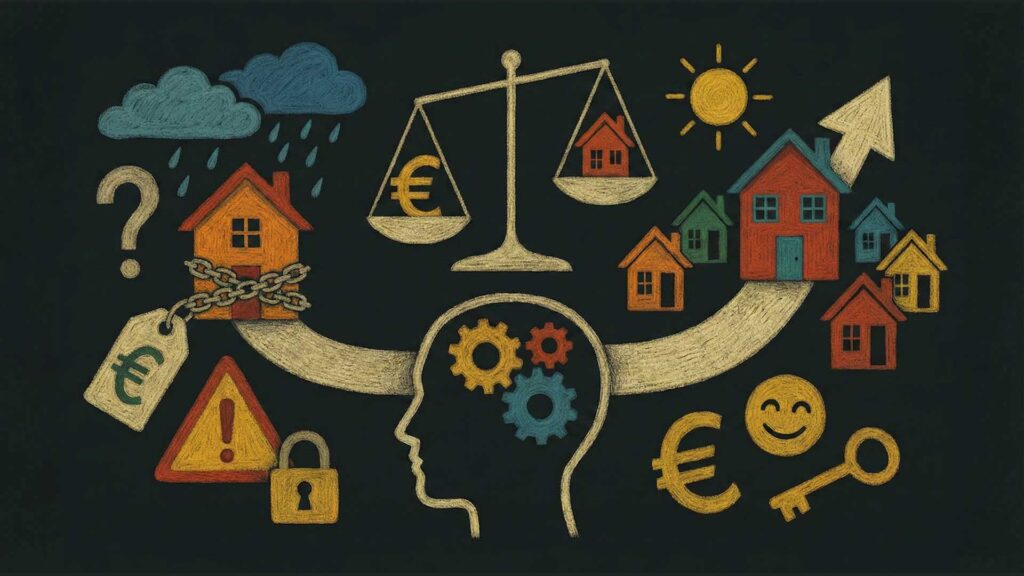
When we look at the Finnish housing market in 2026, we see that it has undergone an exceptional period of transition. The euphoria created by zero interest rates and continuous price increases in previous years has been replaced by a new kind of realism that has tested the nerves of many investors. However, the market is not just numbers in an Excel spreadsheet or interest rates in bank contracts; it is a living, breathing organism driven by the emotions, fears, and hopes of thousands of individual players.
Right now, the collective mindset of Finnish real estate investors is characterized by an interesting, even contradictory tension between caution and latent opportunism. To understand market movements, we need to understand the inner world of investors.
Fear of defeat and mechanisms of paralysis
One of the most fundamental factors influencing investor decision-making isloss aversion,a conceptpopularized by Nobel Prize-winning psychologist Daniel Kahneman. The core of the theory is simple but grim: people experience the pain of loss about twice as strongly as the joy of a gain of the same magnitude.
When markets decline or stagnate, this mechanism is strongly activated, and in Finland this has been evident in recent years as a clear psychological freeze. Many investors have remained in a wait-and-see mode even when cold logic would have favored lightening or restructuring their portfolios with regard to poorly performing investments. The fear of realizing a loss or selling at the very bottom leads to inaction. Reports from Statistics Finland and the Bank of Finland have long reflected low volumes in the housing market, which is not only a sign of rising financing costs but also of investors' wait-and-see attitude. When the future looks foggy, people often default to inaction – forgetting that inaction is also an active choice that comes at a price.
This stagnation is closely linked toanchoring. Investors tend to compare current prices to some fixed point in the past, often the peak of 2021, even though the macroeconomic environment is now completely different. This mental anchor makes current market prices difficult to swallow. If a neighboring stock was sold at a certain price a few years ago, it is psychologically difficult for an investor to accept that the market value of their own target is now lower, even if the target's cash flow remains healthy. Journalistic discussions, such as analyses in the financial media, often highlight the gap between buyers' and sellers' prices. This gap is not just a matter of mathematics, but a psychological distance between the security of the past and the uncertainty of the present.
The illusion of freshness clouds the long-term outlook
At market turning points, investors are often also affectedbyrecency bias. This refers to the human mind's tendency to place disproportionate weight on recent events and forget longer-term history.
After several years of falling prices and rising interest rates, investors begin to project this recent past directly into the future. A feeling arises that "this is the new normal" and that the boom will never return. This is a dangerous misconception in real estate investing, which is essentially a long-term wealth-building activity. The recency bias causes investors to forget the cyclical nature of the housing market and the fact that urbanization and the need for housing are trends that will outlast individual economic downturns. When the media is full of headlines about the plight of the construction industry, it is difficult to remember the times when there were bidding wars for apartments – even though those times are not so far away.
The illusion of control and the impossibility of perfect timing
On the other side of the coin are investors who are not paralyzed by fear, but fallprey tothe illusion of control. These investors believe they can perfectly time the market bottom. They follow every statistic and indicator, believing that they have some special ability to see the turnaround before others.
This often leads to excellent buying opportunities being missed because people are waiting for a further slight drop in prices – that "final" bottom, which can only be seen in the rearview mirror. The housing market is slow-moving and illiquid, and does not behave like the stock market, where the bottom can be reached in a single day. Investors who live under the illusion of control overestimate their own abilities and underestimate the complexity of the market, which can lead to a loss of returns just as much as excessive caution.
Regional differences in psychology: Helsinki vs. Tampere
When these general psychological principles are examined at a practical level, it becomes apparent how they manifest themselves in completely different ways in different parts of Finland. A comparison of the two major growth centers, Helsinki and Tampere, reveals interesting differences in investor sentiment.
In Helsinki, we are currently seeing a strong phenomenon known asthe endowment effect. This refers to people's tendency to value something they already own considerably higher than what they would be willing to pay for it if they were in the role of buyer. In the capital region, where prices have risen almost continuously for a decade, many long-term owners are mentally locked into the higher valuation levels of the past. Sellers experience price reductions as a personal loss, while buyers – influenced by the recency bias – expect prices to fall even further. This has created a stagnant market situation in Helsinki, where the psychological threshold for trading is high.
Tampere, on the other hand, represents the powerofsocial proof and strong storytelling. When enough experts, media outlets, and fellow investors repeat the story of Tampere's exceptional appeal and growth potential, it becomes a collective truth in the eyes of investors. The market psychology in Tampere has remained considerably more optimistic than in Helsinki, even though the economic realities are the same there. Investors there are often guided bynarrative bias: we humans love good stories, and the story of "Finland's most dynamic city" is so powerful that it may overshadow some of the rational, number-based risk analysis.
The herd provides security, but clouds judgment.
Behind all of the above liesa strongherd mentality. Humans are social animals, and this also applies to investing. We feel safe when we do the same as others. When the general mood is cautious, it is mentally difficult for investors to go against the flow and buy when others are selling or waiting.
This is whereconfirmation bias often comes into play. Investors who are already pessimistic about the market focus their attention on news that confirms their fears—such as reports of construction companies going bankrupt—and ignore positive signals, such as growth in rental demand or stabilizing interest rates. This creates a self-perpetuating negative cycle.
Towards a new balance: Mind control is an investor's most important tool
The downward trend and increased risk level are not only threats, but also act as a healthy cleansing force for the markets. They weed out short-sighted speculation based on excessive leverage and restore the focus on the fundamentals of investing: location, genuine cash flow, and long-term value creation.
Finnish real estate investors have traditionally been persistent and patient. Current market psychology shows signs of a return to these roots. Once the initial shock of rising interest rates has subsided, rational optimism begins to emerge among investors. This is not blind faith in continuous growth, but rather an understanding that housing is a basic commodity for which demand will not disappear when economic conditions change.
Ultimately, the winner will be the investor who recognizes their own psychological pitfalls. It is the investor who understands when recency bias clouds their view of the future, when anchoring to past prices prevents them from making sensible trades in the present, or when the illusion of control leads them to attempt the impossible task of timing the market. It is impossible to know for sure in advance when the market will bottom out, but controlling one's own mind is the most effective and reliable tool for investors in all market situations.