Real estate assets inherited or received as gifts – what do the 2026 changes mean for investors?
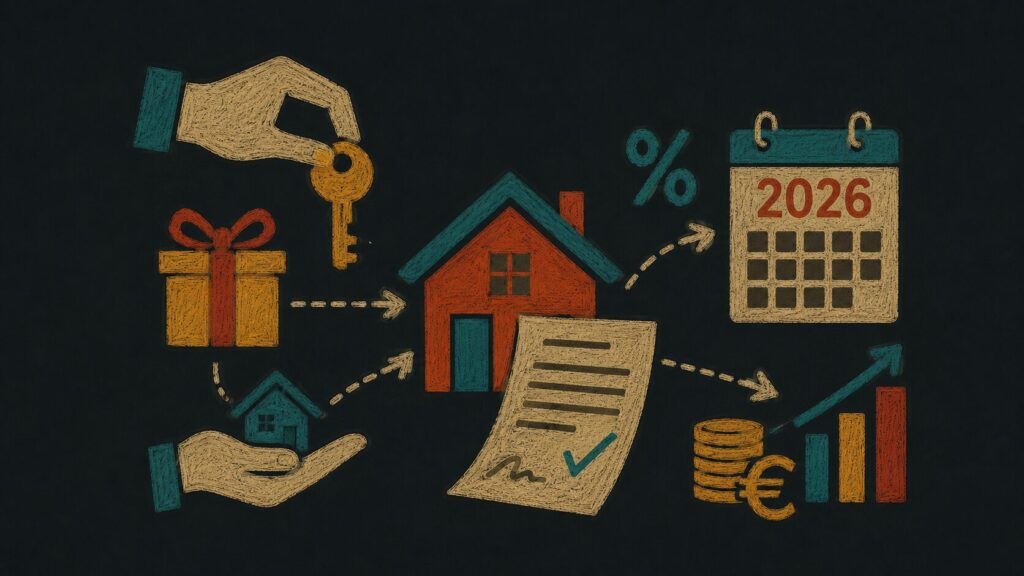
Taxation underwent significant changes at the beginning of the year when the thresholds for inheritance and gift taxes were raised. For real estate investors considering how to pass on their wealth to the next generation, this change opens up new opportunities and requires a strategic approach.
For most people, real estate investing is a long-term endeavor. A natural next step is to pass on the accumulated wealth to children, grandchildren, or other loved ones. In the context of Finnish real estate wealth, this issue is now more relevant than ever, as an increasing number of people have an investment property portfolio that has significantly increased in value and forms the core of their family wealth.
The change that took effect at the beginning of 2026 is worth noting for every investor. The threshold for taxable inheritances rose from €20,000 to €30,000, and the threshold for gifts rose from €5,000 to €7,500. Although these figures may seem small at first glance, they directly affect how one should time the transfer of assets.
What is inheritance and gift tax?
In Finland, inheritance and gift taxes are calculated based on the amount of assets transferred and the degree of kinship. Close relatives—that is, those in the first tax bracket—include spouses, children, grandchildren, and parents. For more distant relatives and other beneficiaries, the tax rate is significantly higher.
In the first tax bracket, taxation does not begin until the inheritance exceeds the 30,000-euro threshold. No tax is paid on shares smaller than this. Gift tax, on the other hand, kicks in at the 7,500-euro mark. This tax-free limit can be utilized every three years, which allows for the systematic and completely legal division of assets.
Gift tax brackets (Tax Class 1) in 2026
| Value of the gift | At the lower tax threshold | Tax on the excess amount |
|---|---|---|
| €7,500 – €25,000 | 100 € | 8 % |
| €25,000 – €55,000 | 1 540 € | 10 % |
| €55,000 – €200,000 | 4 540 € | 12 % |
| €200,000 – €1,000,000 | 21 940 € | 15 % |
| Over €1,000,000 | 141 940 € | 17 % |
Source: Tax Administration 2026
A gift or an inheritance—which is more cost-effective?
There is no single answer to this, but certain principles can help guide your decision. Making gifts during your lifetime allows you to transfer assets in smaller amounts, which keeps the progressive tax burden moderate compared to a large inheritance transferred all at once. Since the tax-free limit has risen to 7,500 euros, transferring small amounts—for example, to support a child’s investment portfolio—is now more flexible than ever.
When it comes to apartments, the situation is often more rigid, as it is difficult to divide the property into parts. If an apartment worth 120,000 euros is gifted in its entirety, the tax is calculated on the full amount at once. In this case, the gift tax would be approximately €7,060. If the same apartment were transferred as the sole inheritance, the tax would be calculated on the portion exceeding €30,000, resulting in a tax liability of approximately €7,540. The differences can therefore be small, which underscores the importance of these calculations.
The Hidden Costs of Capital Gains Tax
One of the most critical mistakes made when transferring home equity is forgetting about capital gains tax. Donating a home does not trigger capital gains tax for the donor, but it shifts the tax burden to the recipient.
If the recipient sells the apartment before one year has passed since the gift was made, the donor’s original purchase price is considered the acquisition cost. If, on the other hand, the recipient keeps the apartment for more than a year, the fair market value used for gift tax purposes is confirmed as the acquisition cost. This “time window” is a vital tool for real estate investors in tax optimization.
Example:If a parent bought an apartment for €60,000 and it is gifted with a value of €150,000, the child should generally wait at least a year before selling it. This way, they can avoid paying tax on the €90,000 increase in value that accrued during the parent’s lifetime.
Gift-based marketing is an effective tool
Investors should also keep in mind transactions that are considered gifts. If an asset is sold to a child for no more than three-quarters of its fair market value, the transaction is considered to consist of a paid portion and a gift portion.
This is often an excellent way to pass on an investment property to the next generation. The child can take out a mortgage to pay the purchase price to the parent, and the remainder of the property’s value is transferred as a gift. The parent does not incur capital gains tax if they sell the property at or below their original purchase price, and the child gains ownership of the property with less capital.
Retaining control reduces the tax liability
Retaining the right of use is an effective way to reduce gift tax. When an investor donates an apartment but retains the right to use it for life, the apartment’s taxable value decreases significantly. The Tax Administration calculates the deduction based on the donor’s age and the apartment’s income.
This model is particularly well-suited to situations where a parent wants to transfer ownership but continue to collect rental income during retirement. The child gains ownership and the potential for future appreciation, while the parent retains control and the cash flow.
Corporate Structure and the Importance of Early Planning
In larger portfolios, the corporate structure offers stability. It is often easier to bequeath shares than to divide up individual units, and the corporate structure allows for the equitable treatment of multiple heirs.
Planning for a generational transition is a process that takes years, not a one-time decision. The sooner you start, the better you can take advantage of the tax-free limits that reset every three years and the benefits offered by control rights. The most important thing, however, is to have an open discussion within the family: is the next generation willing and able to continue in the role of landlord, or would it make more sense to convert the assets into another form before the transfer?
Sources:
- Finnish Tax Administration, Inheritance and Gift Tax 2026:https://www.vero.fi/henkiloasiakkaat/omaisuus/lahja/
- Tax Administration, Inheritance Tax:https://www.vero.fi/henkiloasiakkaat/omaisuus/perinto/
- The Central Association of Taxpayers, Tax Changes 2026:https://www.veronmaksajat.fi/tutkimus-ja-tilastot/suomen-verot-ja-menot/veromuutokset/veromuutoksia-2026/
- Finnish Tax Administration, Capital Gains Tax:https://www.vero.fi/henkiloasiakkaat/omaisuus/asunnon-myynti/
- Tax Administration, Retention of Title in Donations:https://www.vero.fi/syventavat-vero-ohjeet/ohje-hakusivu/48505/hallintaoikeuden-pidattaminen/
- Tax Administration, Transactions of a Gift Nature:https://www.vero.fi/syventavat-vero-ohjeet/ohje-hakusivu/48493/lahjanluonteinen-kauppa/
- Finlex, Section 47 of the Income Tax Act:https://www.finlex.fi/fi/laki/ajantasa/1992/19921535#L4P47